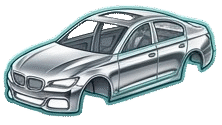
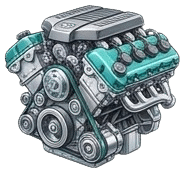
We ship to all 34 cities listed below, and to any address in Quebec that a courier reaches. Small parts go by parcel, engines and body panels on a pallet.
Free, if a seller is near you. The only sensible option for an engine if you can get there.
Lights, mirrors, alternators, wheels. A few days , whichever carrier comes out cheapest.
Engines, doors, bumpers, seats — on a pallet. Costs more, takes longer, needs a tailgate if you have no dock.
Exact price appears once you enter your address — quoted from live carrier rates, not a table.
A used OEM part runs 50 to 80 percent below the dealer price for the same item. A front headlight assembly the dealer sells for $400–600 costs $120–250 used. A bumper cover in the region of $500–700 new goes for $140–260. A complete engine with 60,000 km on it is $1,200–2,200 against $5,000 and up for a replacement crate unit.
The gap is not a quality trade-off. These are the manufacturer's own parts, taken off vehicles that were written off — not aftermarket copies built to approximate the shape. Fitment, connectors, mounting points and paint depth all match, because they came off the same production line as the part you are replacing.
An insurer declares a car a total loss when the repair estimate passes roughly two-thirds of its market value. That threshold catches a lot of three- and four-year-old cars with damage to one corner and nothing wrong anywhere else — a rear-ended sedan still has an untouched engine, undamaged doors on the driver's side, a clean interior and working electronics.
Those vehicles go to dismantlers, who pull everything serviceable and list it. That is the inventory you are looking at: parts off cars that were roadworthy last month, priced as salvage because the shell was written off.
Every body panel carries the donor VIN. Body shops and provincial inspectors ask for it on structural repairs, and it is printed on the invoice — not something you have to chase down afterwards.
Match the part number, not the model year. Manufacturers change parts mid-cycle without changing the model name. The OEM number stamped or printed on your old part is the only reliable match — search by it and the fitment question answers itself.
Look at where it mounts, not where it shows. A door skin can look perfect and still be rotten along the bottom seam. On any panel older than about five years, the mounting points and the underside tell you more than the painted face.
Electronics may need coding. Modules, clusters and some lighting units are paired to a specific vehicle. They work, but a shop has to code them in — worth budgeting for before you order.
Ask about the donor. Mileage, which side took the impact, whether the car ran when it arrived. Any seller who pulled the part themselves can answer in a sentence.
Calling round a dozen yards to ask who has your part is how this used to work, and it still works — if you have the afternoon. The problem is that each yard only knows its own shelves, so you are dialling blind and taking whatever the fourth call turns up.
Searching a shared catalog inverts that: you see who actually has the part, what condition it is in, what it costs and how fast it reaches Quebec — then decide. Sellers here are dismantlers, salvage yards and independent parts stores, all listing from their own real inventory.
Yes — to any address a courier or freight carrier reaches. Small parts go by parcel, engines and body panels on a pallet. The price is quoted at checkout from live carrier rates, so you see the real number before you commit, not an estimate that changes later.
If the seller is near you, yes — and for anything that would otherwise ship on a pallet, it usually saves more than the part costs to deliver. Pickup is shown as an option at checkout when it applies.
You have 30 days from confirmed delivery to request a return. If the part was wrong, damaged or not as described, the shipping comes back too — that is the platform standard every seller here signs up to.
It is standard practice, which is why the donor VIN matters. Inspectors want to trace a structural component back to the vehicle it came from; with the VIN on the invoice, that box is ticked before the part arrives.
Search by the OEM number off your old part — that is the exact match. Failing that, search by make, model and year, then check the number on the listing against yours before ordering.